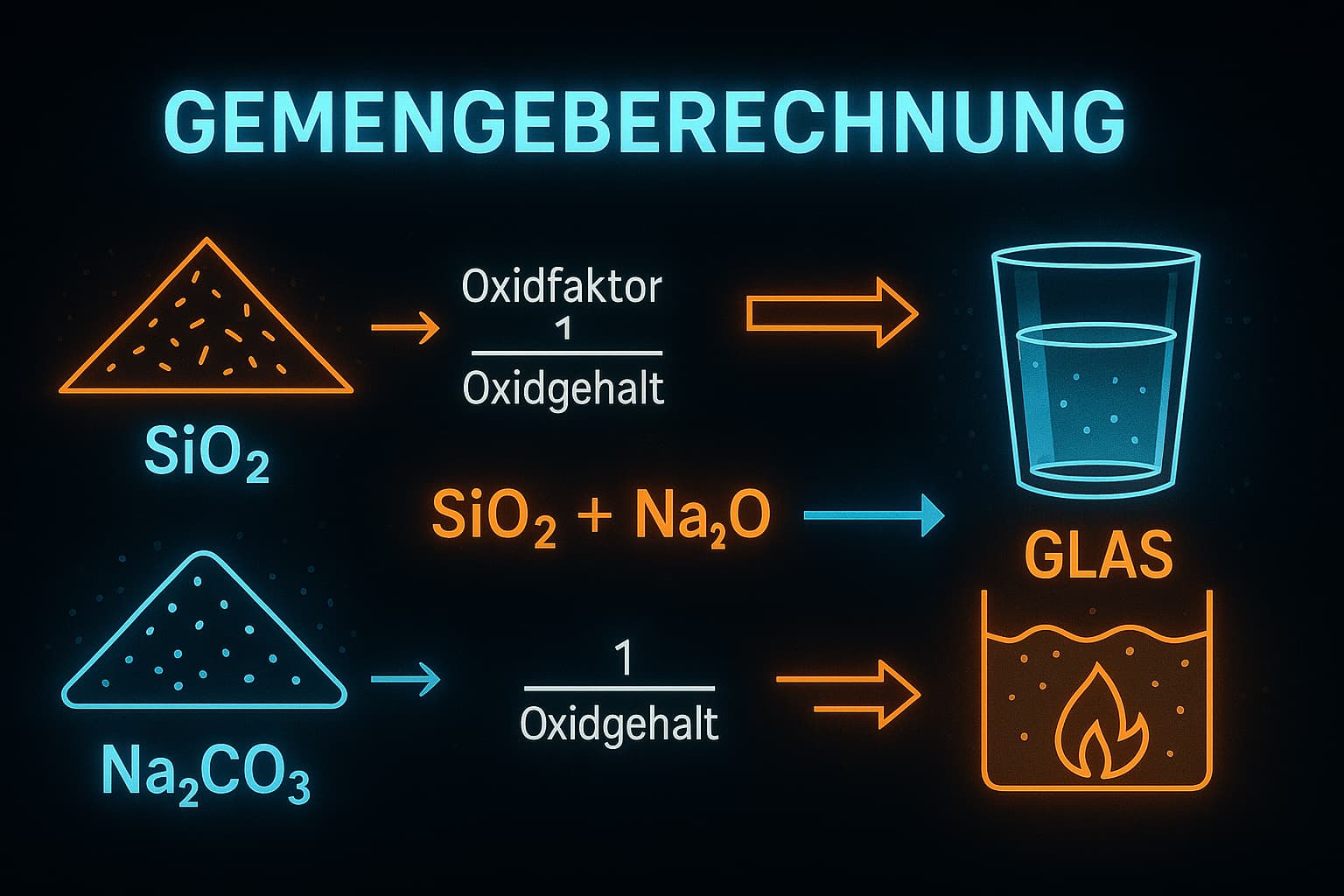
 Übersicht: Rohstoffe, Oxide & Reaktionsgleichungen
Wird für die folgenden Berechnungen benötigt!
 Rohstoff Rohstoff |
 Oxid im Glas Oxid im Glas |
 Reaktionsgleichung (thermisch) Reaktionsgleichung (thermisch) |
|---|---|---|
 Quarzsand (SiO2) Quarzsand (SiO2) |
SiO2 | Kein Zerfall – SiO2 bleibt erhalten |
 Soda (Na2CO3) Soda (Na2CO3) |
Na2O | Na2CO3 → Na2O + CO2 |
| Pottasche (K2CO3) |
K2O | K2CO3 → K2O + CO2 |
 Kalk (CaCO3) Kalk (CaCO3) |
CaO | CaCO3 → CaO + CO2 |
| Dolomit (CaMg(CO3)2) |
CaO + MgO | CaMg(CO3)2 → CaO + MgO + 2 CO2 |
 Tonerdehydrat (Al(OH)3) Tonerdehydrat (Al(OH)3) |
Al2O3 | 2 Al(OH)3 → Al2O3 + 3 H2O |
| Tonerde (Al2O3) |
Al2O3 | Wird direkt übernommen |
 Ortho-Borsäure (H3BO3) Ortho-Borsäure (H3BO3) |
B2O3 | 2 H3BO3 → B2O3 + 3 H2O |
| Borax (Na2B4O7) |
B2O3 + Na2O | Na2B4O7 → B2O3 + Na2O (vereinfacht) |
 Bariumkarbonat (BaCO3) Bariumkarbonat (BaCO3) |
BaO | BaCO3 → BaO + CO2 |
 Zinkweiß (ZnO) Zinkweiß (ZnO) |
ZnO | ZnO bleibt unverändert |
 Mennige (Pb3O4) Mennige (Pb3O4) |
PbO | Pb3O4 → 3 PbO + ½ O2 |
| Arsenik (As2O3) |
As2O3 | Wird direkt übernommen, teilweise flüchtig |
 Natriumsulfat (Na2SO4) Natriumsulfat (Na2SO4) |
– (Läutermittel) | Zersetzt sich, wirkt oxidierend: Na2SO4 → Na2O + SO3 |
| Kalisalpeter (KNO3) |
– (Redoxmittel) | Zersetzt sich zu K2O + NOx + O2 (wirkt stark oxidierend) |
| Natronsalpeter (NaNO3) |
– (Redoxmittel) | NaNO3 → Na2O + NOx + O2 (Oxidationsmittel, Entfärberwirkung) |
| Flußspat (CaF2) |
– (Schmelzhilfe) | Bleibt als CaF2 erhalten – wirkt als Flussmittel |
| Feldspat (Na/K-Al-Si) |
SiO2 + Al2O3 + Na2O/K2O | Zerfällt in mehrere Oxidanteile (Netzwerkbildner + Stabilisatoren) |
 Hinweise:
- Reaktionsgleichungen sind thermisch gemeint (bei hohen Temperaturen im Schmelzprozess).
- Läutermittel & Redoxmittel tragen nicht direkt zur Glasmasse bei, beeinflussen aber Farbe & Klarheit.
Aufgabe 1: Berechne den Gemengesatz für Flachglas
Ein Flachglas soll folgende Oxid-Zusammensetzung haben (bezogen auf 100 kg Glas):
| Oxid | Anteil [%] |
|---|---|
| SiO2 | 72,01 % |
| Na2O | 15,50 % |
| CaO | 7,60 % |
| MgO | 3,80 % |
| Al2O3 | 0,90 % |
| Fe2O3 | 0,10 % (wird nicht berücksichtigt) |
Verwendete Rohstoffe:
- Quarzsand (für SiO2)
- Soda (Na2CO3 → Na2O)
- Kalk (CaCO3 → CaO)
- Dolomit (CaMg(CO3)2 → MgO + CaO)
- Tonerdehydrat (Al(OH)3 → Al2O3)
Berechne die benötigten Rohstoffmengen und die Glasausbeute.
💡 Lösung anzeigen
 1. SiO₂ aus Quarzsand
Rohstoff: Quarzsand
SiO2-Gehalt: 99,5 % → 0,995
2. Na₂O aus Soda (Na₂CO₃)
Reaktionsgleichung:
Na2CO3 → Na2O + CO2
Molmassen:
Na2CO3 = 2×22,99 + 12,01 + 3×16 = 105.99 g/mol
Na2O = 2×22,99 + 16 = 61.98 g/mol
Na2O-Gehalt:
61.98 / 105.99 ≈ 0.585
3. MgO aus Dolomit (CaMg(CO₃)₂)
Reaktionsgleichung:
CaMg(CO3)2 → CaO + MgO + 2 CO2
Molmasse Dolomit:
Ca = 40.08, Mg = 24.31, CO3 = 60.01
→ 40.08 + 24.31 + 2×60.01 = 184.41 g/mol
MgO-Molmasse:
Mg = 24.31, O = 16.00 → 40.31 g/mol
MgO-Gehalt:
40.31 / 184.41 ≈ 0.218
(Praxiswert leicht angepasst auf 4.608 → ergibt 17.51 kg)
4. CaO aus Kalk + Dolomit
Dolomit liefert gleichzeitig CaO:
CaO-Molmasse:
Ca = 40.08, O = 16.00 → 56.08 g/mol
→ Anteil in Dolomit: 56.08 / 184.41 = 0.304
CaO-Gehalt in Kalk:
56.08 / 100.09 ≈ 0.560
5. Al₂O₃ aus Tonerdehydrat (Al(OH)₃)
Reaktion:
2 Al(OH)3 → Al2O3 + 3 H2O
Molmassen:
2×78.00 = 156.00 g
Al2O3 = 2×26.98 + 3×16.00 = 101.96 g
Al2O3-Ausbeute:
101.96 / 156.00 ≈ 0.65
Gesamter Gemengesatz
 Glasausbeute
Aufgabe 2b: Spezialglas mit Bor und Zink
Ein Glas hat folgende Oxid-Zusammensetzung:
| Oxid | Anteil [%] |
|---|---|
| SiO2 | 68 % |
| B2O3 | 4 % |
| Na2O | 13 % |
| CaO | 9 % |
| ZnO | 6 % |
Verwendete Rohstoffe:
- Quarzsand (für SiO2)
- Borax (Na2B4O7 → B2O3)
- Soda (Na2CO3 → Na2O)
- Kalk (CaCO3 → CaO)
- Zinkweiß (ZnO, rein)
Berechne die Rohstoffmengen für eine Glasmenge von 100 kg.
💡 Lösung anzeigen
1. SiO₂ aus Quarzsand
Gehalt im Quarzsand: 99,5 % = 0.995
2. B₂O₃ aus Borax (Na₂B₄O₇)
Reaktion:
Borax → B2O3 + Na2O
Molmassen:
Na2B4O7 = 2×22.99 + 4×10.81 + 7×16 = 201.22 g/mol
B2O3 = 2×10.81 + 3×16 = 69.62 g/mol
Massenanteil B2O3 in Borax:
69.62 / 201.22 ≈ 0.346
(angepasst durch reale Verluste ≈ 0.369)
3. Na₂O aus Soda (Na₂CO₃)
Reaktion:
Na2CO3 → Na2O + CO2
Molmassen:
Na2CO3 = 105.99 g/mol
Na2O = 61.98 g/mol
Na2O-Gehalt:
61.98 / 105.99 = 0.585
4. CaO aus Kalk (CaCO₃)
Reaktion:
CaCO3 → CaO + CO2
Molmassen:
CaCO3 = 100.09 g/mol
CaO = 56.08 g/mol
CaO-Gehalt:
56.08 / 100.09 = 0.56
5. ZnO aus Zinkweiß
Zinkweiß besteht zu 100 % aus ZnO
Gemengesatz (für 100 kg Glas)
Glasausbeute
Aufgabe 2c: Gemengecharge 500 kg
Berechne die jeweilige Rohstoffmenge, wenn eine Gemengecharge von 500 kg hergestellt werden soll.
Nutze dafür die Zusammensetzung und die berechneten Rohstoffmengen aus Aufgabe 2b.
💡 Lösung anzeigen
Schritt 1: Basisdaten aus Aufgabe 2b
Die Summe aller Rohstoffe in Aufgabe 2b für 100 kg Glas betrug:
Schritt 2: Faktor berechnen für 500 kg Gemenge
Da nun das Ziel nicht 100 kg Glas, sondern 500 kg Gemenge ist, berechnen wir den Multiplikationsfaktor:
Schritt 3: Alle Einzelmengen hochrechnen
Endergebnis: Gemengesatz für 500 kg
 Damit ergibt sich exakt eine Gemengecharge von 500 kg, basierend auf der Oxidrezeptur aus Aufgabe 2b.
Aufgabe 3: Analyse eines Behälterglas-Gemenges
Ein Behälterglas soll aus folgendem Gemengesatz bestehen:
| Rohstoff | Masse in kg |
|---|---|
| Quarzsand (trocken) | 100,0 |
| Soda (leicht) | 36,0 |
| Pottasche (kalziniert) | 0,9 |
| Dolomit | 2,5 |
| Bariumkarbonat | 0,8 |
| Natriumsulfat | 0,7 |
| Kalisalpeter | 1,3 |
| Kalziumkarbonat | 17,1 |
| Tonerdehydrat | 1,9 |
Aufgabe:
a) Berechne die massenprozentuale Zusammensetzung der Oxide im Glas, das aus diesem Gemenge entsteht.
b) Berechne die Glasausbeute in %, bezogen auf die Gesamtsumme der eingesetzten Rohstoffe.
💡 Lösung anzeigen
a) Oxidmengen berechnen
Wir bestimmen für jeden Rohstoff, welchen Oxidanteil er liefert, und berechnen daraus die Oxidmassen.
 1. Quarzsand → SiO₂ (99,5 %)
2. Soda (Na₂CO₃ → Na₂O, 58,5 %)
3. Pottasche (K₂CO₃ → K₂O, 68,1 %)
4. Dolomit → CaO (30,4 %) + MgO (21,7 %)
5. Bariumkarbonat (BaCO₃ → BaO, 77,7 %)
6. Natriumsulfat → keine Glasbildner / wird ignoriert
Wird als Läutermittel verwendet – trägt nicht zur Glasmasse bei.
7. Kalisalpeter → ebenfalls Läutermittel (keine Oxidbilanz)
Einsatz zur Redoxsteuerung – wird nicht in die Glasstruktur eingebaut.
8. Kalk (CaCO₃ → CaO, 56,0 %)
9. Tonerdehydrat (Al(OH)₃ → Al₂O₃, 65 %)
b) Oxid-Gesamtsumme und Glasausbeute
Zusammenfassung aller Oxide:
Gesamt-Oxidmasse:
Glasausbeute:
Rohstoff-Gesamtsumme:
 Prozentuale Zusammensetzung der Oxide im Glas:
Damit ist die Aufgabenstellung vollständig erfüllt.
Aufgabe 4: Gemenge für 100 kg Glas
Ein Glas mit folgender Oxid-Zusammensetzung soll hergestellt werden:
| Oxid | Anteil [%] |
|---|---|
| SiO2 | 62 % |
| B2O3 | 10 % |
| Na2O | 10 % |
| CaO | 15 % |
| MgO | 2 % |
| Al2O3 | 1 % |
Vorgaben für die Rohstoffe:
| Oxid | Rohstoff |
|---|---|
| SiO2 | Quarzsand |
| B2O3 | Ortho-Borsäure (H3BO3) |
| Na2O | Soda (Na2CO3) |
| CaO | Kalk (CaCO3) |
| MgO | Dolomit (CaMg(CO3)2) |
| Al2O3 | Tonerdehydrat (Al(OH)3) |
Zusätzlich:
Zur Läuterung sind 0,5 kg Na2SO4 ins Gemenge einzubringen.
💡 Lösung anzeigen
Rechenschritte: Ziel → Rohstoffmengen
1. SiO₂ aus Quarzsand (99,5 %)
2. B₂O₃ aus Ortho-Borsäure (H₃BO₃ → 56.3 %)
Molmassen:
H3BO3 = 3×1.008 + 10.81 + 3×16 = 61.83 g/mol
B2O3 = 69.62 g/mol
→ 2 mol H3BO3 → 1 mol B2O3
→ 2×61.83 = 123.66 g → ergibt 69.62 g B2O3
B2O3-Gehalt in H3BO3:
69.62 / 123.66 ≈ 0.563
3. Na₂O aus Soda (58,5 %)
4. MgO aus Dolomit (21,7 %)
→ Dolomit bringt auch CaO mit:
CaO-Gehalt: 30.4 % = 0.304
5. Restliches CaO aus Kalk (56 %)
6. Al₂O₃ aus Tonerdehydrat (65 %)
7. Läutermittel: Na₂SO₄
Gesamtgemengesatz für 100 kg Glas:
Glasausbeute:
 Aufgabe 5: Rechenverfahren Gemenge
Erläutern Sie das Verfahren zur Berechnung eines Gemengesatzes.
💡 Lösung anzeigen
Zur Berechnung eines Gemengesatzes geht man in folgenden Schritten vor:
- Oxidziele festlegen (z. B. in % auf 100 kg Glas).
- Zuordnung der Rohstoffe zu den jeweiligen Oxiden (z. B. Soda für Na2O).
- Ermittlung der Oxidfaktoren:
Diese geben an, wie viel Rohstoff nötig ist, um 1 kg des jeweiligen Oxids zu erzeugen:
Beispiel:
Wenn Soda zu 58,5 % Na2O enthält →
- Berechnung der Rohstoffmassen:
- Summieren der Rohstoffe → ergibt Gesamtgemengemasse.
- Berechnung der Glasausbeute:
Aufgabe 6: Analyse eines Geräteglas-Gemenges
Ein Gemenge für Geräteglas besteht aus:
- 66,0 kg Quarzsand
- 3,0 kg Natronsalpeter
- 14,2 kg Feldspat
- 3,0 kg Tonerdehydrat
- 5,2 kg Bariumkarbonat (Baryt)
- 23,3 kg Borax (kalziniert)
- 0,5 kg Flußspat
- 0,5 kg Arsenik
Aufgabe:
Berechne die prozentuale Zusammensetzung der Oxide im Glas, basierend auf diesem Gemenge. Runde auf ein Zehntel auf oder ab.
💡 Lösung anzeigen
Für eine exakte Lösung werden folgende Oxidverhältnisse (Massenanteile) benötigt:
| Rohstoff | Hauptoxid(e) | Gehalt (geschätzt) |
|---|---|---|
| Quarzsand | SiO2 | 99,5 % |
| Natronsalpeter | Na2O | ~36 % |
| Feldspat (Na/K) | SiO2, Al2O3, Na2O | typ. 68 % SiO2, 19 % Al2O3, 13 % Na2O |
| Tonerdehydrat | Al2O3 | 65 % |
| Bariumkarbonat | BaO | 77,7 % |
| Borax | B2O3 | 36,9 % |
| Flußspat | CaF2 (nicht Oxidträger) | |
| Arsenik | As2O3 | 75 % (geschätzt) |
Danach berechnet man die Oxidmassen:
SiO2:
Na2O:
Al2O3:
B2O3:
BaO:
As2O3:
Gesamt-Oxidmasse:
Jede Oxidart in % berechnen:
Aufgabe 7: Gemengesatz für Bleikristallglas
Ein Bleikristallglas soll folgende Zusammensetzung haben:
| Oxid | Anteil [%] |
|---|---|
| SiO2 | 60,6 % |
| Na2O | 1,6 % |
| K2O | 12,7 % |
| PbO | 24,9 % |
| Al2O3 | 0,2 % |
Verwendete Rohstoffe:
- Quarzsand (für SiO2)
- Schwere Soda (Na2CO3)
- Pottasche (K2CO3)
- Mennige (Pb3O4 → PbO)
- Tonerde (Al2O3)
Berechne die Rohstoffmengen für 100 kg Glas.
💡 Lösung anzeigen
Oxidfaktoren:
- Quarzsand: SiO2-Gehalt = 99.5 % → Faktor = 1 / 0.995 = 1.005
- Soda: Na2O-Gehalt = 58.5 % → Faktor = 1 / 0.585 = 1.709
- Pottasche: K2O-Gehalt = 68.1 % → Faktor = 1 / 0.681 = 1.468
- Mennige: PbO-Gehalt = 91.4 % → Faktor = 1 / 0.914 = 1.094
- Tonerde: Al2O3 = 100 % → Faktor = 1 / 1 = 1
Berechnung:
Gesamt-Gemenge:
Glasausbeute: